Of all the things we get asked to take away, hot tubs generate the biggest gap between what people expect and what the job actually involves.
The expectation is usually that a couple of people will tip it on its side and walk it out. The reality is that a six-person spa weighs several hundred pounds empty, is wider than every gate on the property, and has been sitting on the same patio slab for eleven years with a plant growing through the skirt.
So here is the real version.
Step one: it has to be empty. Properly empty.
A full hot tub holds several hundred gallons. Water weighs about 8.3 pounds a gallon, so a 400-gallon spa is carrying over 3,000 pounds of water. Nothing happens until that is gone.
Draining is straightforward but slow. Most units drain by gravity through a valve at the base, which can take a couple of hours. A submersible pump cuts it considerably.
Two things people miss:
- Where the water goes matters. Recently chlorinated or brominated water should not go straight into a storm drain or onto planting. Let it sit a few days so the sanitiser dissipates, then drain to a sanitary sewer clean-out or across turf.
- Gravity drains leave water behind. There is always some sitting in the footwell, the pipework and the pump housing. It comes out at the worst moment during the tip unless it has been pumped down.
If it is at all practical, drain it the day before we come. It genuinely changes the job.
Step two: the electrical disconnection
This is the part that is not negotiable.
Most hot tubs are hard-wired to a dedicated 240-volt circuit through a GFCI disconnect. That is not something to improvise around. The circuit needs to be shut off at the panel and the unit properly disconnected — and where it is hard-wired rather than plugged in, that is a licensed electrician's job.
Plug-in 120-volt units are simpler: unplug it and you are done.
Tell us which you have when you call. If it is hard-wired and not yet disconnected, get an electrician in first — otherwise we arrive and cannot legally or safely start.
Step three: teardown
This is the bulk of the work and the reason it is not a ten-minute job.
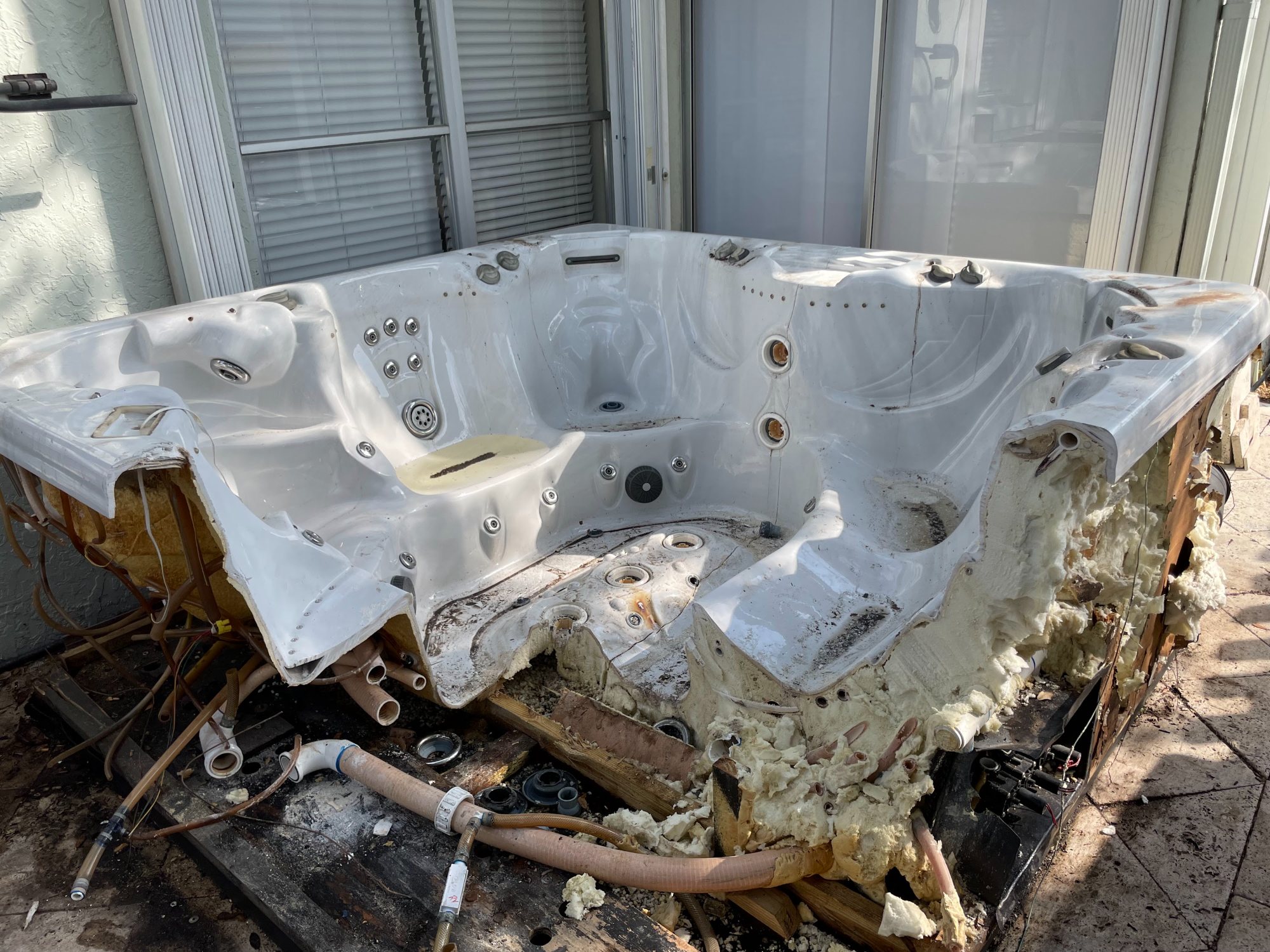
A typical spa is built as: an acrylic or fibreglass shell, a plywood or composite cabinet skirt, a timber frame, an insulating layer of sprayed foam filling the cavity, and a full loom of plumbing and wiring threaded through it.
Taking it apart usually runs:
- Cover and cover-lifter off — the cover alone is often 50 to 80 pounds and waterlogged covers are heavier still
- Cabinet panels off
- Pump, heater and control pack disconnected and removed
- Frame cut down
- Shell cut into sections that will actually go through the gate
The foam is the messy part. It is sprayed in place around the plumbing, it breaks up into a lot of small pieces, and it goes everywhere in a breeze. Containing it is most of what makes the difference between a tidy job and a patio you are still picking bits out of a week later.
Step four: getting it out
Almost always through a side gate, because almost nobody wants a dismantled spa carried through the house — and quite reasonably.
The constraints we look at on arrival: gate width, any step or level change, the turn from the patio into the side return, and whether the truck can get close enough to the front that we are not carrying sections a hundred feet.
This is why we quote hot tubs on site rather than by phone. The teardown is predictable; the route out is not.
Above-ground pools are the same job, bigger
Same sequence: drain, disconnect, dismantle, haul. Differences are that the volume of water is far greater — draining is a genuine planning exercise rather than an afternoon — and the liner, wall and frame come apart into large awkward panels.
What is underneath is its own conversation. A pool that has been up for years leaves a dead circle of ground, sometimes sand or a base pad. If that has to come out too, tell us so it is in the quote.
What it costs
Hot tubs and above-ground pools are priced as teardown plus volume, and they are always quoted on site.
What moves the number: size, whether it is drained and disconnected before we arrive, the route out, and whether there is decking or surround coming with it.
What you can do to keep it at the lower end: drain it in advance, have the electrical disconnection done, and clear the route to the gate.
What happens to it
More of it is recoverable than you would guess. The pump, heater and control pack are metal and go to recycling. The frame fasteners and any metal structure go the same way. Occasionally a unit is recent enough and sound enough that the working components are worth passing on rather than scrapping.
The shell and the foam are the genuinely spent parts and those go to disposal.
Booking it
Call (954) 536-8189 and tell us the size, whether it is drained, whether it is hard-wired or plug-in, and roughly what the gate looks like. A photo of the tub and a photo of the side gate is all we need.
It is a half-day job done properly, and it is one of the more satisfying ones — people have usually been staring at it for two years.
Need this done rather than read about?
Free quote, firm price given on site before anything moves, and same-day service across Coral Springs and all of Broward County. Licensed and insured — and we do every bit of the lifting.